Hamatech
HMR900
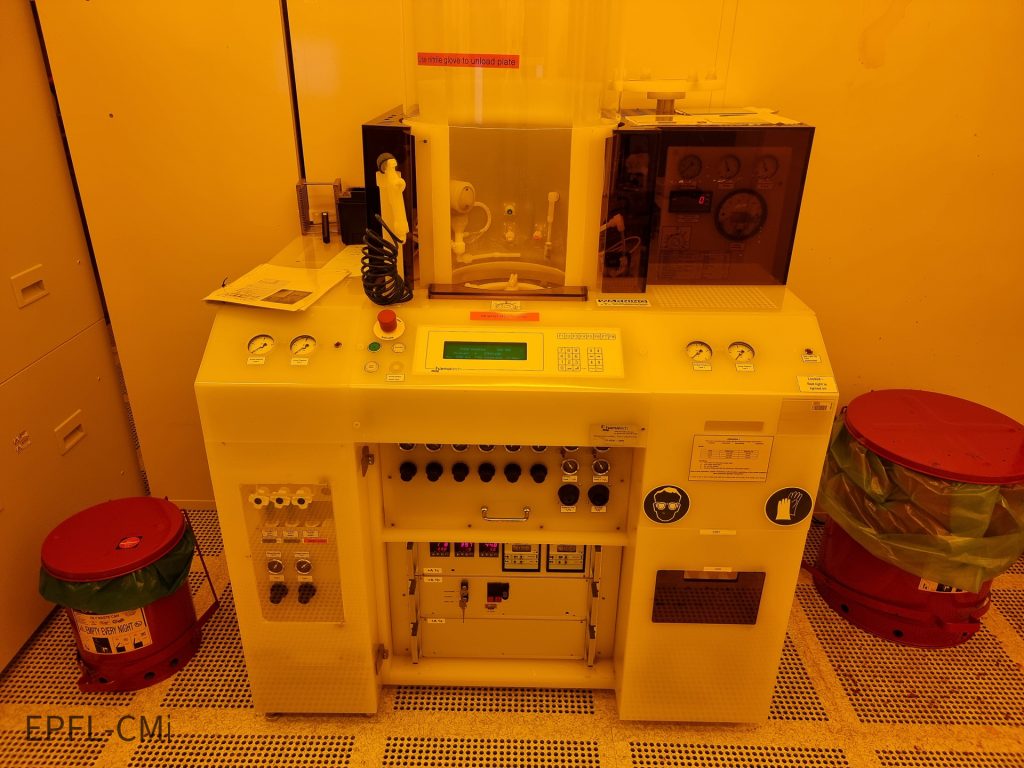
The Hamatech HMR900 is a mask processor dedicated to Cr-plate wet processing and cleaning. The Hamatech HMR900 handles square plates up to 7 x 7 inches, including 4, 5, and 7 inch masks for mask-aligner usage and 6 inch reticules for DUV stepper usage. The Hamatech HMR900 performs developing, chromium wet etching, and resist stripping using three dedicated chemical media.[1]
Wafer size
4"
Performance
+/-1 rpm[1]
Gas delivery
Cr wet etching with TechniEtch Cr N°1[1]
Optics
Mask processor[1]
What it is
The Hamatech HMR900 is a mask processor designed for wet processing of chrome (Cr) plates. The tool is dedicated to Cr-plate wet processing or cleaning.[1]
The HMR900 handles square plates up to 7 inches by 7 inches, including 4-inch, 5-inch, and 7-inch masks for mask-aligner usage, and 6-inch reticles for DUV stepper usage.[1]
How it works
The HMR900 uses manual loading and unloading of substrates. Substrates are fixed by mechanical side-edge fixation; for Cr plates, vacuum clamping is not used, only mechanical corner-stops hold the plates during processing.[1]
The HMR900 can store and run up to twenty recipes, each with up to fifty steps. Three dedicated chemical media are installed: AZ 351B developer for exposed resist, TechniEtch Cr N°1 for chrome etching, and AZ 400K non-diluted for resist stripping, with intermediate deionized water rinse steps and final drying.[1]
Where it fits in the process flow
The tool performs sequential wet processing steps: developing the exposed resist, etching the chrome layer, and stripping the remaining resist. The final drying step completes the mask processing.[1]
What can it run?
Process applications and technology nodes documented for this tool.
- Developing exposed resist
- Cr wet etching
- Resist stripping
Why won't it start?
Documented failure modes, common issues, and field considerations.
- Chucks for Cr plates do not use vacuum clamping; only mechanical corner-stops hold the plates during processing.
- Take care for correct substrate loading.
What do the numbers mean?
Vacuum & pumping2
- Substrate fixation
- Mechanical side edge substrate fixation; chucks for Cr plates do not use vacuum clamping[1]
Wafer handling11
- Substrate size
- Square plates up to 7 x 7 inches; chucks for 4 x 4, 5 x 5, 6 x 6, and 7 x 7 inch square plates[1]
Gas & chemistry6
- Installed media
- Developing exposed resist (AZ 351B developer), Cr wet etching (TechniEtch Cr N°1), and resist stripping (AZ 400K non-diluted)[1]
- Chemical media
- AZ 351B developer, TechniEtch Cr N°1, AZ 400K non-diluted, with DI water rinse and drying[1]
- Process steps
- developing exposed resist, Cr wet etching, resist stripping, intermediate DI water rinse steps, and final drying[1]
Optics & imaging3
- Supported mask and reticle types
- 4, 5 and 7 inch masks for mask-aligner usage; 6 inch reticules for DUV stepper usage[1]
Performance2
Control & software4
Configuration & options6
What replaced it?
Related models
- siblingEV Group EVG 150source[2]
What does it need to run?
Site utility requirements, footprint, and infrastructure needed to install and operate this tool. Sourced from public records.
- Installed mediaDeveloping exposed resist (AZ 351B developer), Cr wet etching (TechniEtch Cr N°1), and resist stripping (AZ 400K non-diluted)[1]
- Substrate fixationMechanical side edge substrate fixation; chucks for Cr plates do not use vacuum clamping[1]
- Substrate fixationMechanical side edge (corner-stops), no vacuum clamping[1]
- Chemical mediaAZ 351B developer, TechniEtch Cr N°1, AZ 400K non-diluted, with DI water rinse and drying[1]
- Chemical treatment 1Developing exposed resist with AZ 351B developer[1]
- Chemical treatment 2Cr wet etching with TechniEtch Cr N°1[1]
- Chemical treatment 3Resist stripping with AZ 400K non-diluted[1]
- Process stepsdeveloping exposed resist, Cr wet etching, resist stripping, intermediate DI water rinse steps, and final drying[1]
Where are the manuals?
Publicly hosted documents referencing this tool, linked at their original location. Hosted by the linked institutions — availability may change.
- User ManualManualepfl.ch
Generated from public-source data on file. Enter your email to access — nothing is published; details are routed privately.
Not publicly documented
Field notes
No research found yet — worked with this tool? Share what you know.
Frequently asked questions
What substrate sizes does the HMR900 handle?
The HMR900 handles square plates up to 7 inches by 7 inches, including 4-inch, 5-inch, and 7-inch masks and 6-inch reticles.[1]
What chemical processes are performed on the HMR900?
The tool processes exposed resist development using AZ 351B, chrome etching using TechniEtch Cr N°1, and resist stripping using AZ 400K non-diluted, with intermediate DI water rinses and final drying.[1]
How many recipes can be stored on the HMR900?
The HMR900 can store twenty recipes, each with up to fifty steps.[1]
How are substrates held in the HMR900?
Substrates are held by mechanical side-edge fixation. For Cr plates, vacuum clamping is not used; instead, mechanical corner-stops hold the plates during processing.[1]
What rotation modes are available on the HMR900?
The HMR900 supports direct (clockwise) and reverse (counterclockwise) rotation.[1]
Not publicly documented
The following facts about the HMR900 are absent from this record as of this revision. First-hand knowledge or a citation closes a gap; every submission is reviewed before publication.
No publicly documented production dates or lifecycle milestones (introduction, end of production, EOL) for the HMR900 are on record.
Answerable by: OEM historical records or a trade-press announcement
No publicly documented variants, configuration options, or revision breakpoints of the HMR900 are on record.
Answerable by: an OEM product catalog or an engineer who ordered or specified the tool
The control-system platform and OS era of the HMR900 are not on record.
Answerable by: an engineer who operated it or OEM installation records
The process node or technology generation of the HMR900 is not on record.
Answerable by: an OEM datasheet or a fab qualification report
No publicly documented compatible parts, consumables, or accessories for the HMR900 are on record.
Answerable by: an OEM parts catalog or a service engineer
Sources & citations
Last updated Oct 8, 2026.
Compare with similar tools
View all →
The Nikon NSR-1505G4 is a wafer stepper with 5x reduction for 5-inch reticles and 4-inch wafers, using g-line UV and providing better than 750 nm resolution and better than 150 nm alignment.

The Nanoscribe Photonic Professional GT+ is a 3D nanoprinter for two-photon polymerization using an infrared 780 nm femtosecond laser.
Brooks 017-0146-01 is a prealigner manufactured by Brooks.